
What the platform reports
Representative datasets from the DrugUptech screening platform. All traces are from live cells in 96-well plates on a standard fluorescence reader.
Three Gram-negative pathogens on one plate
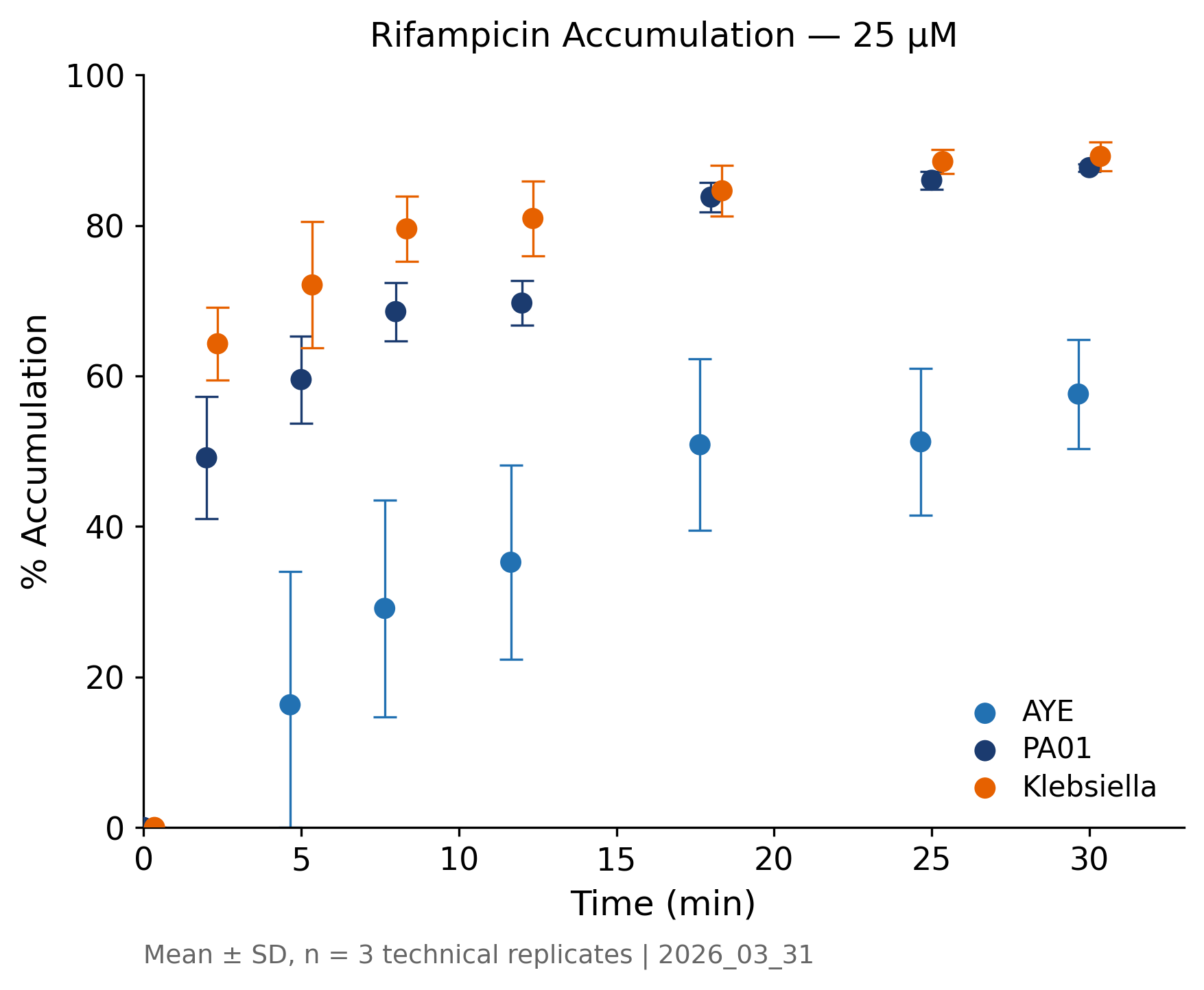
Rifampicin accumulation in Acinetobacter baumannii AYE, Pseudomonas aeruginosa PA01 and Klebsiella pneumoniae, followed over 30 minutes.
Rifampicin, 25 µM. Mean ± SD, n = 3 technical replicates. Direct-fluorescence mode. Time zero is the addition of compound.
Why this matters for your chemistry
An accumulation deficit alone does not tell a medicinal chemist what to fix. Knowing that the loss is efflux points to pump-avoiding modifications; knowing it is permeability points to porin-friendly properties. The platform resolves the two in a single experiment and repeats cheaply as analogues arrive.
Beyond bacteria
The same measurement has been transferred to Candida, human cell lines (Caco-2, HEK293T), plant protoplasts and leaf discs from any plant species. Mammalian and plant experiments run over hours rather than minutes and are set up per project.
A broad detection window
The displacement-mode reporter was screened against a library of 55 clinically approved drugs spanning diverse chemotypes, with a limit of detection around 150 nM for responsive compounds. Detection mode is confirmed for every compound during project set-up, so you know before the uptake run whether it is measurable.
Have a dataset like this in mind for your compounds?
Send us a shortlist and the organisms or cells that matter. We will propose the panel, the benchmarks and the timeline.