
Real-time uptake intelligence for drug and agrochemical discovery
DrugUptech measures how much of your compound actually reaches live bacteria, mammalian cells or plant tissue, in real time and without labels. We run the assay, you get a go/no-go answer weeks earlier.
Contract research service · University of Kent spinout · Validated in bacteria, fungi, human cell lines and plant tissue
Potent on the target. Silent in the cell.
Compounds selected for activity against an isolated target routinely fail against the intact organism because too little of them gets inside. Measuring that step has been slow, destructive or impossible, so most programmes discover the problem late.
Sources: PMC/NIH (2022); GBD/IHME (2021); WHO AMR Surveillance (2023); UN/FAO crop loss reporting.
Quantitative accumulation data from live cells, in a plate reader
A proprietary fluorescent detection system reports compound accumulation as it happens, in the organism that matters to you. No radiolabels, no chromatography, no cell lysis.
Real time
A complete kinetic profile from a single sample. Rates, plateaus and half-times, not just an endpoint.
Label-free
Unmodified compounds, straight from your library. Nothing to synthesise, tag or radiolabel.
Any cell type
Gram-negative and Gram-positive bacteria, fungi, human cell lines, plant cells and intact leaf tissue.
Scalable
Runs in standard 96-well plates on a standard fluorescence reader. Many compounds and strains per plate.
Built for teams that need to know whether the compound gets in
Antimicrobial discovery
Rank hits by accumulation in Gram-negative pathogens, resolve efflux from permeability, and pair uptake with MIC in the same programme.
Antimicrobial servicesAgrochemicals & biostimulants
Specialised protoplast viability and uptake analysis for actives, biostimulants and elicitors, with leaf-tissue assays. The only uptake platform validated in plant systems.
Plants & protoplastsSmall-molecule drug discovery
Cell-based uptake and kinetic profiling in human lines such as Caco-2 and HEK293T, from hit triage through lead optimisation.
Pharma servicesFrom compound library to uptake report
Scope
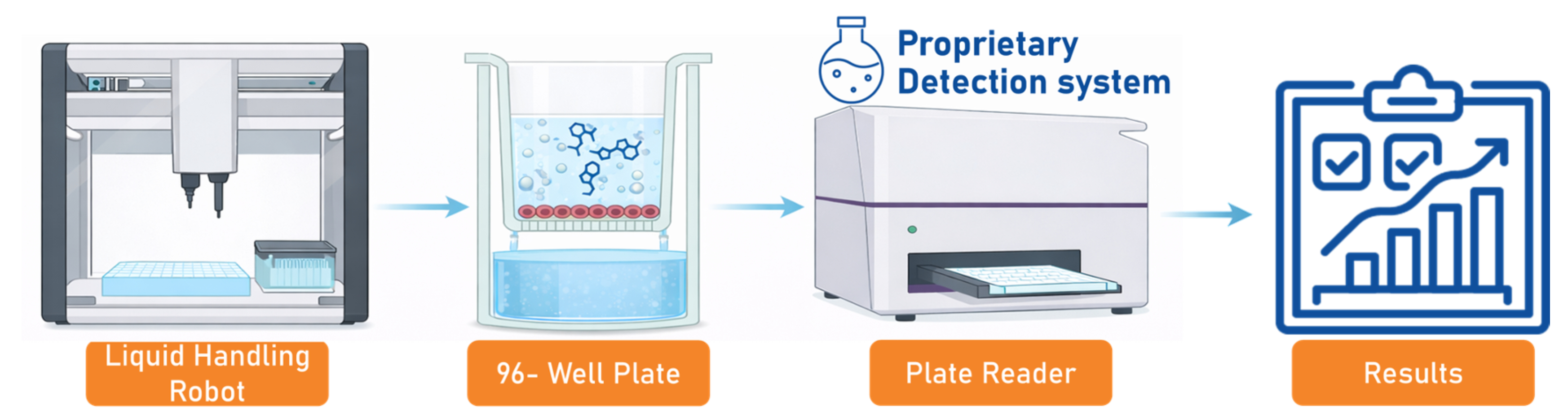
You send compounds and name the organism, cell line or tissue. We agree readouts, concentrations and controls.
Set up
Cells are grown, detection mode is confirmed for each compound and benchmarks are run. Initial report at week 3.
Measure
Compound and cells are combined with the detection reagent and fluorescence is followed in real time on a plate reader.
Report
Percentage accumulation, kinetics and optional viability or efficacy data, benchmarked against reference compounds.
One plate, three pathogens, a full uptake time course
Rifampicin accumulation in Pseudomonas aeruginosa PA01, Acinetobacter baumannii AYE and Klebsiella pneumoniae followed over 30 minutes.
Because the readout is kinetic, the same data give uptake rate and plateau for each strain, and adding an energy source lets us separate active efflux from reduced permeability.
Browse example data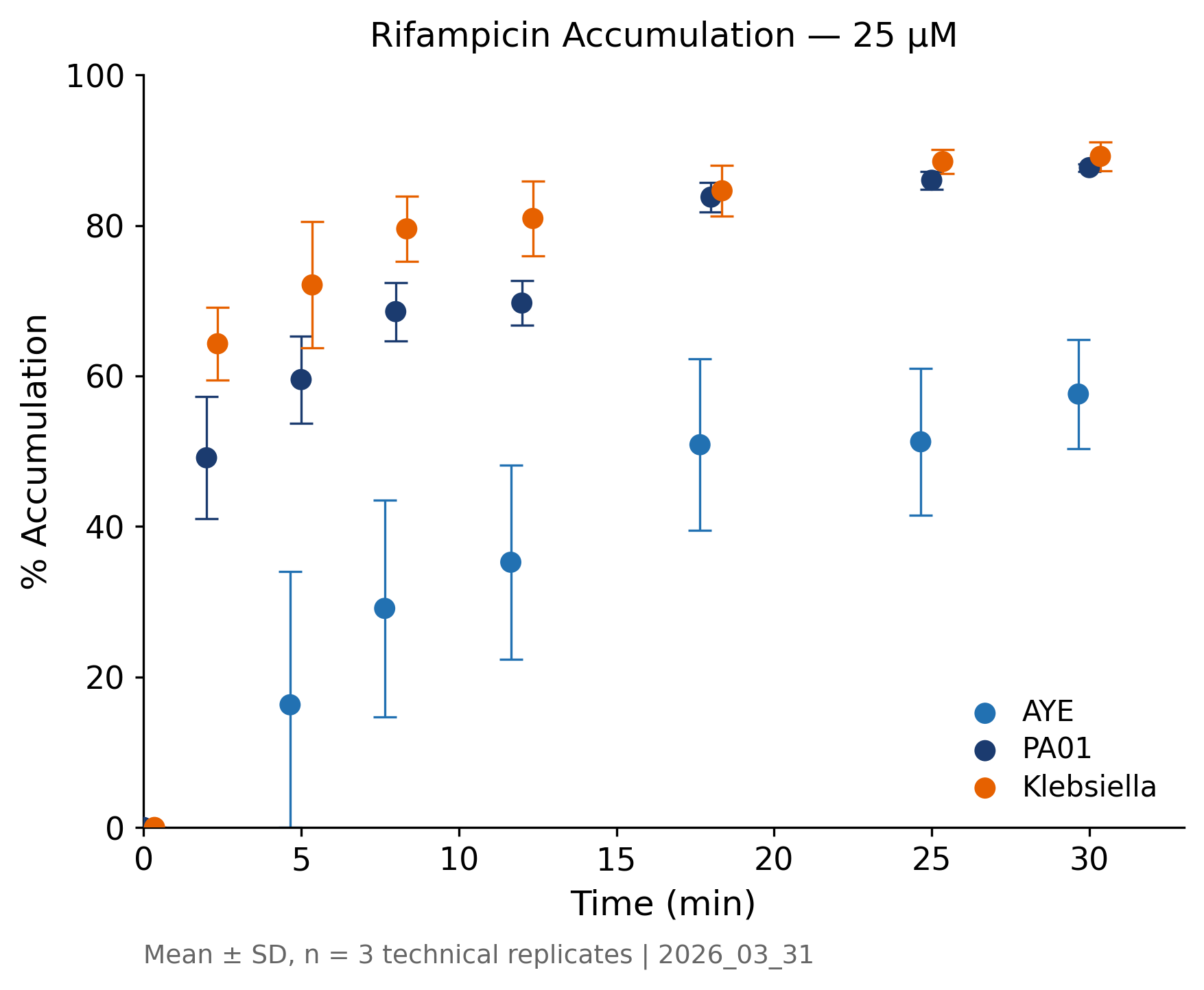
A typical project
Fixed scope, fixed timeline, one point of contact. Every project is scoped individually, so tell us what you need to decide and we will propose the assays.
Project start
Compounds received, organisms and readouts confirmed.
Set-up report
Detection check per compound, MIC50 or dose range, benchmarks.
Full uptake report
Accumulation, kinetics, efflux contribution and optional viability or efficacy.
Ready to see how much of your compound gets in?
Tell us about your compounds and target organisms. We will scope the assay, agree the readouts and return a set-up report within three weeks.